
WWI "Yankee Division" Shoulder Patch
Origins of the “YD” Monogram
In September, 1917 a press conference of Boston newspaper reporters was called by General Clarence Edwards to determine a nickname for the 26th Division which had been newly-formed from New England National Guard units. One reporter (Frank Sibley of The Boston Globe) suggested to “call it the ‘Yankee Division’ as all New Englanders are Yankees.” The “Yankee Division” was thus adopted as the nickname of the 26th Division with a “YD” monogram as its insignia.

Steam engine with "YD" marking

The “Yankee” Division was the first to copy the French and British system of branding all unit vehicles with its insignia. All mules and horses were branded with the “YD” monogram long before the use of Divisional insignia was mandated in the AEF. Motor truck units of the Division also painted sub-unit emblems such as anchors, eagles and replicas of the Bunker Hill Monument (located in Sam’s home neighborhood and pictured here) on their vehicles. These emblems were also the subjects of cave art carved on the limestone walls of quarries in the Chemin des Dames when the troops of the 26th Division first entered the front lines in 1918.
Shoulder Insignia
The wearing of shoulder insignia on the uniform was prescribed for all U.S. Army troops, Corps troops and all Divisions by AEF General Headquarters in the following communication {N. M-674} dated October 20, 1918:
“Each division will adopt and procure immediately some distinctive cloth design which will be worn by every officer and man of the division on the left arm, the upper part to be attached to the shoulder seam. Report will be made to these Headquarters by telegram as to designs adopted in order that there may be no duplication. Approval of design will be made by telegram from these Headquarters.”
In response to this directive, the shoulder patch for the 26th Division was submitted for approval on October 23 consisting of the “YD” monogram in blue cloth matching the color of the French Army uniform on a diamond background of olive drab. The original design was authorized with a subsequent change of the monogram’s color to dark blue. The wearing of this shoulder patch was made compulsory for all men of the 26th Division after November 29, 1918 in orders from First Army Headquarters.
The first shoulder sleeve insignia (such as that pictured above) prior to the Second World War frequently had a make-shift appearance and were manufactured of wool felt-on-felt or other cloth in muted colors. Many of these were very crudely made in the field. Others were embroidered or machine-woven. Later insignia would be mass-produced using full embroidery with a wide range of colors.
Helmet Markings
When painted helmet markings also became widely adopted in the AEF to help identify different organizations, the 26th Division was the only one to select distinctly different insignia for each component unit. Following is a collection of helmets with unique 26th Division unit insignia that have not been lost to history:

26th Division Headquarters

26th Division Headquarters

26th Div. Headquarters Troop

51st Infantry Brigade Headquarters
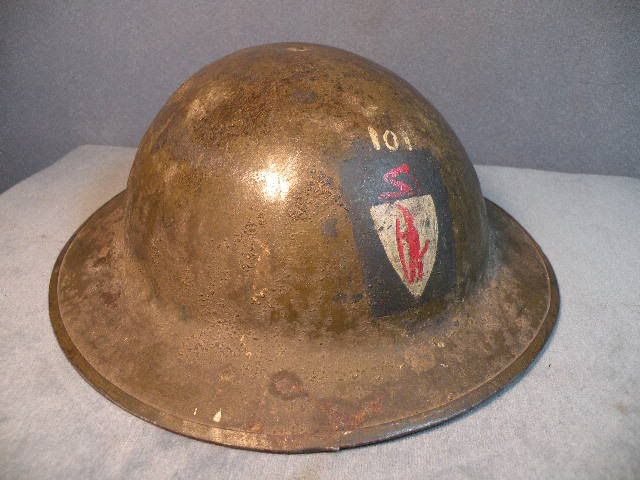
101st Infantry Regiment

101st Machine Gun Battalion

101st Engineers Regiment

101st Mobile Ordnance Repair Shop

101st Field Signal Battalion

101st Sanitary Train

101st Engineer Train

101st Supply Train

101st Ammunition Train

101st Military Police Company

101st Field Artillery Regiment

102nd Infantry Regiment

102nd Machine Gun Battalion

102nd Field Artillery Regiment

102nd Field Artillery Medic

52nd Infantry Brigade Headquarters

103rd Infantry Regiment

103rd Machine Gun Battalion

103rd Field Artillery Regiment

104th Infantry Regiment

26th Division Veteran's Parade Helmet


26th Div. Motor Service Dispatch

26th Div. Helmet Insignia Chart from The Boston Globe, 1919

26th Div. limestone wall carving, possibly 101st ST c.1918 (photo by Michael St. Maur Shell)

Photos of vintage 26th “Yankee” Division helmets courtesy of Bay State Militaria and Antiques. Visit this link to browse and procure distinctive and rare American militaria.



 Soldiers' Mail


 Soldiers' Mail
In regards to the YD patches, the first ones available to the units in France were crudely made in France by the soldiers themselves or local seamstresses. I had the honor of interviewing a member of Co.K, 101st Infantry several years ago. At the time he was 102 years old and still recalled clearly much of the war in France. He related to me the story of “Cootie Mary” and how she was the local elder seamstress for his group of fellows and she did the sewing on of the patches when they were approved. She also did repairs on socks, etc. One can only imagine how she got that nickname, knowing that all the soldiers of the YD were inflicted with body lice for most of their time in France. Uniform seams were ripe places for lice. Troops of course were officially deloused at irregular intervals during the war, but “Cootie Mary” probably had no access to this process.
My name is Doug Ely. I live in Palm Bay Fl. I am trying to do research for the family of a ww1 vet by the name of Edmund Merchant. I was told he won the purple heart & silver star for actions in France. I would like to know where he is buried and I do believe he was in the 26th Yankee div. I do not know his rank or unit branch. He was from Everett Mass. The family would love to have any info available. I do not have a unit history with names. Hopefully somebody out there could help us out with this.
Thank you very much. Looking forward to hear more about Edmund Merchant.
Hi,
Nice website. I am a long time collector of 26TH Division material and you have some great items shown here. I enjoyed your effort and insight to shed light on this under appreciated unit.
Scott Kraska
My grandfather, Col. Dwight T Colley, was a commander of the 104th unit and I’m trying to locate any articles or photos from either WWI or WWII, both of which he served in and received Distinguished Service Cross from each war. Thanks in advance for any information you can share. Regards, Marion Daniel
Hi, my Great Uncle Pvt Manuel Martin was a member of Co G 104th US Infantry AEF. He was KIA in Apremont France in April, 1918. I wanted to know if anyone had any information on this or the family etc. He is a native of the Azores but lived in Lowell MA.
I came across a helmet whose liner had the Yankee Division insignia. Someone had painted the helmet exterior with white paint. After carefully removing the white paint from helmet exterior, I found remnants of what appears to have been an insignia in yellow paint. I have attached photos of the helmet with remnant insignia, and would appreciate any information on which insignia it may be. The helmet also had two vertical bars in white at the back of the helmet (or possibly the number “11”). If you can make out what the insignia may have been with the images located on my MSN skydrive at:
https://skydrive.live.com/redir?resid=9598F13BAB967D77!1005&authkey=!ALiBLQry7oS9cJc
I would greatly appreciate your forwarding the info to my email address attached to this post.
Thank you,
Michael
Hello! I have a helmet identical to the one photographed on this page entitled 102nd Field Artillery Regiment – can someone tell me is this was used in WWI and if so in what country was it worn during the war? It has a red canon, the YD and number 102 on it. What year range would it have been used during the war? Is this part of the 26 division and not sure what that means. Thank you for any history can give for a description of this helmet collected by my father. Was told it is a WW1 Yankee Division 102 Auxiliary. Would anyone know the approximate value of this hat and how highly collectible it is? Thank you very much.
Hi,My name is Howard Matteson Clark and my grandfather was in the Yankee Division in was in Nov 14 1917 to Aug 14 1919 if there is anyone out there that can help me get more Information of were he was and any Medals he got I would greatly be thankful to you and God bless you and your family. Yours Howard Clark Oh his name was Howard Roger Matteson from Cheshire CT.
Thanks for the great web site! I finally found the Divisional insignias on my ww1 helmet. It was the 102nd maple tree, Thanks. Nick Ski
Hi – my great grandfather was in the Yankee Division – 102nd Field Artillery, Battery D. Would love to know if anyone has any information about the 102nd FA.
I have my wife’s great uncles helmet….103 M.G. BN, finally able to ID unit…
I have a book on the History of the YD. My Dad received it on the 50th anniversary of the Division.
My grandfather Michael Anthony McMahon had five battle stars with the YD was with the 103rd machine gun battalion , he fought at both the St Mihiel and Meuse Argonne offensives , he was from Roxbury Mass ,